It occurs to us that it might help you as the reader understand what we are looking for when we are looking for representation. We have taken the Bechdel Test for women and modified it for various groups that we are curious about representation for.
Female Representation:
1-There have to be two named female characters.
2-There must be dialogue between the female characters.
3-The dialogue must be about something besides men.
LGBTQ Representation:
1-The character is identifiable as LGBTQ.
2-The character is not defined solely by their sexuality.
3-The removal of the character would affect the plot.
People of Color Representation:
1-There have to be 2 (or more) named characters.
2-There should be dialogue between those characters.
3-The characters should not be romantically involved.
4-The dialogue should not be centered on a white character.
People with Disabilities Representation:
1-The character is identifiable as disabled.
2-The character is not defined by their disability alone.
3-The removal of said character would have significant effect on the plot.
4-The character does not wallow in their disability.
Mental Health Representation:
1-The character accurately portrays some form of mental health struggle.
2-The villain is not defined solely by a mental health struggle.
3-The character is not wallowing in their mental health struggle.
4-Does the character have allies and friends that acknowledge and help them with their struggle.
Tuesday, October 1, 2019

Monday, September 30, 2019
How to Train Your Dragon: The Hidden World
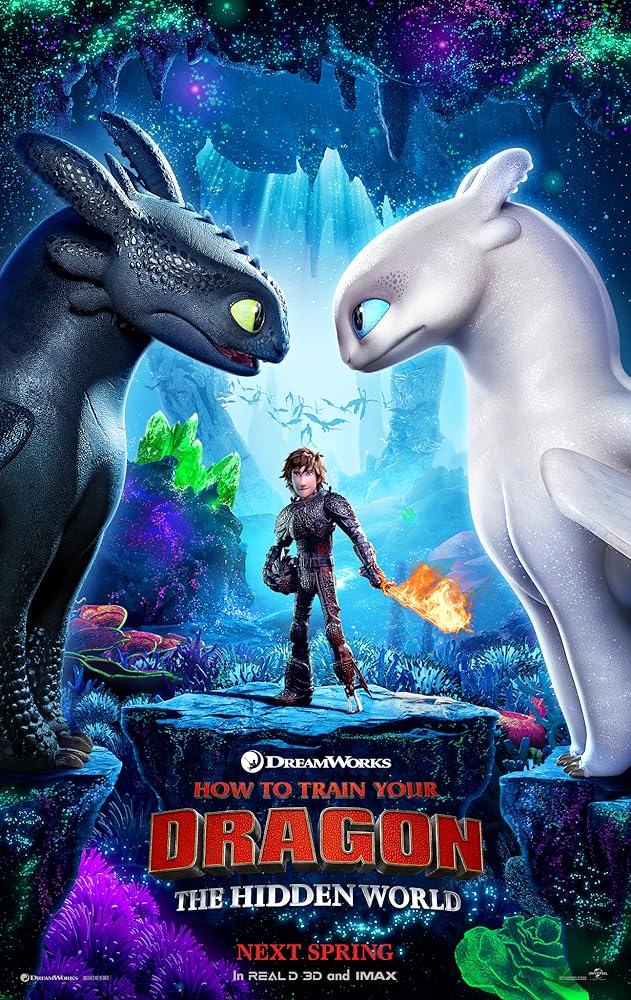
How to train your dragon: the hidden world came out on February 22, 2019 and I only just watched it yesterday so to say I'm coming in late might be a bit of an understatement. I think the main reason I put off seeing this film is that I was rather critical of the second movie. My gripes in retrospect are pretty small (that sword would be next to useless in battle you would probably be better off with a burning log and powers from out of nowhere toothless). While I've shaken off some of that negativity it will probably come back at some point.
This negativity probably original came from the fact that I first read and still am a fan of the original books that these films take inspiration from. I say 'take inspiration' not 'based on' because the book and the movies are nothing alike. Luckily someone already made a video about how they are totally different beasts so I can just put the link here (expect some swearing) and not worry about explaining the difference.
Now before I dive into representation there are a few nitpicks I want to get off my chest. First off the movie felt like it was trying to do too many things at once and I feel that if they had paired it down and polished up what they wanted to focus on the end result would have been better. Secondly it felt like the charterers only overcame the villain by repeatedly basing their head against him, while thematically appropriate for horn helmeted vikings it's not nearly as satisfying as out thinking and out maneuvering a cunning villain.
On the positive side the performance of the villain (whose name I didn't bother to commit to memory) was very well done. The visual design and the body language add wonderfully to the smug calculating superiority that he exudes and the handful of scenes we get with him tell us that he is a force to be reckoned with. When he stated talking about how human are superior and thus are the ones worthy to dominate I had gotten my hopes up that he was making a twisted villainous commentary on the theme of the film, such as villain are want to do.
While 'being weak doesn't make you unworthy' is not the theme of this film, the series as a whole actually dose some good work with representing disability, just not with hiccup as you might think. Even though this film did better than the second one reminding us that hiccup is down a foot (that disregard of disability is another reason why I didn't like the second film) he isn't the series best disabilities representative. It's toothless.
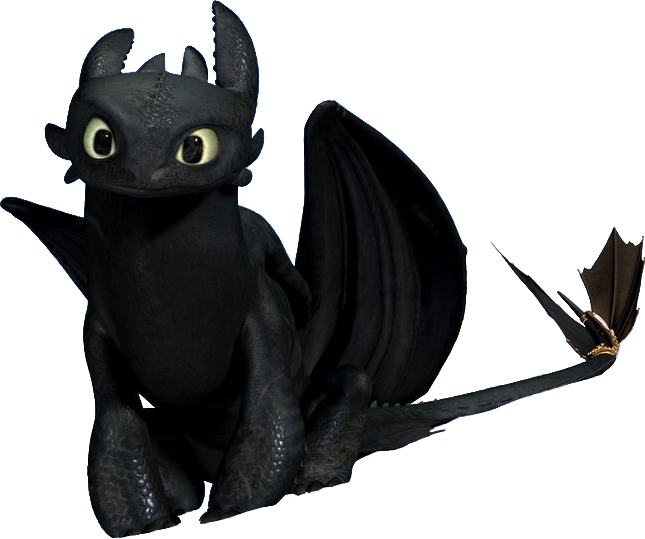
In each film toothless passes with flying (HA) colors. He lost half his tail fin early in the first film leaving him unable to fly on his own. This inability to fly alone is used as a plot point multiple times in each of the films. However when most people think of toothless they don't think of that wounded dragon that can't fly by himself they think of that awesome black dragon that goes real fast and acts like a cat. His disability doesn't define his character rather his disability adds to it.
One of the aspects that makes this portrayal work so well is the aspect of interdependence. Toothless enables hiccup and hiccup enables toothless. I feel that if writers focused less on making their characters independently competent and more on being competent as a group they will find it easier to portray disabled characters.
While this film doesn't represent other under represented groups (it falls one question short of the Bechtel test) I can't help but respect it for giving us a mascot that almost everyone instantly recognizes on site that has been a quiet example of how to properly write disabilities.
Sunday, September 22, 2019
Aladdin (2019)

From a non-Middle Eastern or North African perspective, Aladdin seems to do a lot for cultural representation. Disney cast actual people of color instead of whitewashing the story, as it has been popular to do with other movies (ie. Death Note, Aloha, Prince of Persia). If I hadn’t read about the backlash the movie got, I would think that it did an exceptional job. Again, this would be coming from a Latin-American 18-year-old with little to no experience with Middle Eastern culture. But I did read actual perspectives from Middle Eastern viewers. One of the articles I read brought up orientalism and the way this film exudes just that. It seems that Agrabah—originally meant to be Baghdad—is a bunch of different cultures meshed together with zero distinctions or blatant significance. As Maha AlbadrawiI puts it, “it feels like the filmmakers are saying that brown is brown.”
The film passes the Bechdel Test just by a hair. There are only two female characters that are named—Jasmine and Dahlia—and most of their dialogue when speaking to each other is about Aladdin or the genie. Granted, this film did take strides in changing the narrative from Jasmine simply having an interest in Aladdin and wanting to escape marriage with Jafar to wanting to be Sultan herself. It was actually quite refreshing seeing this change, especially after Jafar’s remark at Jasmine, saying it’s “better for you to be seen and not heard.” It breaks my heart how many little girls are taught to have that mindset in which appearance is everything. Jasmine was being forced to stand by and look pretty while she found a prince to marry who would rule her own village. She sought a bigger purpose in this movie, one where she could serve and care for her community.
A major highlight of the movie was Will Smith, hands down. Genie was the one character that they could have tried to cast a white actor for, but they didn’t. Will Smith is iconic and the fact that his persona shined through to Genie’s character made the movie that much better. My favorite part was seeing Will Smith in drag during the Prince Ali performance. Though Genie also dressed in drag in the original Aladdin, seeing it in a real-life performance was much different (perhaps better…..?). It was satisfying seeing bulky, muscular Will Smith as Genie in DRAG. We love the abolishment of gender roles.
Overall, I really enjoyed watching Aladdin. The visuals were great, it was funny, and served to empower little girls. As far as representation goes, however, there is much room for improvement. I’m glad the movie was able to celebrate Middle Eastern culture and shine it in an appealing way (to Westerners at least), but Disney needs to be more careful when it comes to creating movies about marginalized communities to avoid mistakes like the orientalism that the film portrayed. If they’re going to profit off of the portrayal of distant cultures, they might as well to it right.
Tuesday, September 10, 2019
Avengers: Endgame
Spoiler Alert. If you haven’t seen Avenger Infinity War and/or Avengers: Endgame (and want to) STOP READING right now. MAJOR SPOILERS!
I never really liked the character of Thor in the MCU. I know it’s not a popular opinion. He’s overbearing, starts out misogynistic (he gets better), and really, astonishingly perfect. (Except the hair. The day I saw him with the haircut for Ragnorok? That was a good day!) He always did what he was supposed to. He won every battle. He used whoever he needed to get what he wanted, and often didn’t take into account other’s feelings. Annoying, really.

At the end of Infinity War, Thor comes sailing out of the sky and gets Thanos in the heart with his ax. Thor has swooped in and saved the day, again (so irritating).
Except he didn’t.
He really didn’t.
As Thanos said, he “...should have gone for the head.”
Thanos snaps and the world as Thor knows it is absolutely crushed.
Even at the beginning of Endgame when they find Thanos, Thor beheads him, but it’s too little, too late.
The rest of Endgame, for Thor, is why I now like his character.
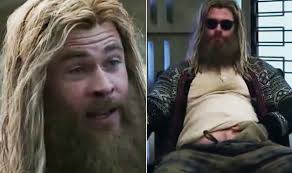
Because Thor is me.
Like Thor, I have a problem in my life that is so much bigger than me I cannot begin to fathom how to solve it.
Like Thor, I’ve gone into depression. I’ve spent years in denial, denial of the situation, denial of myself, thinking that was the only way to fix things. Thor self-medicated with alcohol and video games. I self-medicated with food and books. Thor gained weight. So have I.
Like Thor, I have isolated myself in what looked like a safe place, but was really just me running away.
Like Thor, I lost myself.
Thor’s reactions to his life were just like mine. They were real. In fact, he was the Avenger that I most identified with in Endgame. There, up on the screen in the highest grossing movie of 2019, and one of the highest grossing of all time, was mental health portrayed in a very real way.
Intervention happened for him. His friends pulled him out of his escape, and he came back into the story, but he was still trying to make it all work his way. He still tried to fix things. He still tried to do everything he thought he was supposed to do. And his friends held him back.
He had to go back into his past, literally, and talk to his mom to find himself. This is a psychological tool, talking to the people that are gone. It was only when he tested himself and found out he could still wield his hammer, in spite of his astronomical mistake and the fact that he couldn’t fix it. He found himself.
My change moment wasn’t from the intervention of friends. It was one night when I was in a place of such darkness that I could see no way out, and I started seriously contemplating the various bottles of sleeping pills that are in my house as a way out. I’m still not sure what pulled me away. But I got up and joined the rest of my family in the movie they were watching because the end result of me being alone was going to be suicide.
I’ve been in therapy for years. I take a medication that isn’t technically an antidepressant, but helps. In spite of all that, I was still in the blackest hole I’ve ever been in. And because of that moment, I have taken Thor’s journey.
Like Thor, I have traveled into my past to find myself.
Like Thor, I have tested myself and found that I am still worthy, even with this issue. I can still contribute.
And like Thor, I have come out ahead. I have found myself, will continue to find myself, and will travel the universe.

I don’t think Thor’s journey is over. He’s still overweight. He is still bossy. He’s still a little annoying, but now, ironically, he’s human. He is me. And I love him because I now love myself.
Yes, I know they play him for comic relief. Is that demeaning? Maybe. I don’t know. What I do like is that the writers/directors still took him on a mental health journey, in spite of the comedy. His journey doesn’t have to look exactly like mine. It’s enough that I got to watch him take it.
(If you really want a mental health connection--take the stages of grief and apply them to the main Avengers. Thor=Denial, Black Widow=Depression, Hawkeye=Anger,Captain America=Bargaining [this one feels a stretch], Iron Man and Hulk=Acceptance. Food for thought!)
As for the rest of representation:
Women? Yes. Gratuitous girl power scene (the directors words, not mine!)
LGBTQ? Not obviously to someone who doesn't really live in that world. (I've heard that Valkyrie "gives off Bi vibes" but I don't know what that means.)
People of color? Yes.
Disabilities? Yes? You might remember that War Machine doesn't have use of his legs from Civil War. In Infinity War we find out that Tony a.k.a. Iron Man has made him some amazing tech that allows him to walk. In Infinity War, we don't see his spinal injury affecting him at all. However, in Endgame, there is a scene where his injury does affect him and therefore I'm giving it a Yes.
So far, this is the best of the top 10 movies that I've scene for representation.
I never really liked the character of Thor in the MCU. I know it’s not a popular opinion. He’s overbearing, starts out misogynistic (he gets better), and really, astonishingly perfect. (Except the hair. The day I saw him with the haircut for Ragnorok? That was a good day!) He always did what he was supposed to. He won every battle. He used whoever he needed to get what he wanted, and often didn’t take into account other’s feelings. Annoying, really.
At the end of Infinity War, Thor comes sailing out of the sky and gets Thanos in the heart with his ax. Thor has swooped in and saved the day, again (so irritating).
Except he didn’t.
He really didn’t.
As Thanos said, he “...should have gone for the head.”
Thanos snaps and the world as Thor knows it is absolutely crushed.
Even at the beginning of Endgame when they find Thanos, Thor beheads him, but it’s too little, too late.
The rest of Endgame, for Thor, is why I now like his character.
Because Thor is me.
Like Thor, I have a problem in my life that is so much bigger than me I cannot begin to fathom how to solve it.
Like Thor, I’ve gone into depression. I’ve spent years in denial, denial of the situation, denial of myself, thinking that was the only way to fix things. Thor self-medicated with alcohol and video games. I self-medicated with food and books. Thor gained weight. So have I.
Like Thor, I have isolated myself in what looked like a safe place, but was really just me running away.
Like Thor, I lost myself.
Thor’s reactions to his life were just like mine. They were real. In fact, he was the Avenger that I most identified with in Endgame. There, up on the screen in the highest grossing movie of 2019, and one of the highest grossing of all time, was mental health portrayed in a very real way.
Intervention happened for him. His friends pulled him out of his escape, and he came back into the story, but he was still trying to make it all work his way. He still tried to fix things. He still tried to do everything he thought he was supposed to do. And his friends held him back.
He had to go back into his past, literally, and talk to his mom to find himself. This is a psychological tool, talking to the people that are gone. It was only when he tested himself and found out he could still wield his hammer, in spite of his astronomical mistake and the fact that he couldn’t fix it. He found himself.
My change moment wasn’t from the intervention of friends. It was one night when I was in a place of such darkness that I could see no way out, and I started seriously contemplating the various bottles of sleeping pills that are in my house as a way out. I’m still not sure what pulled me away. But I got up and joined the rest of my family in the movie they were watching because the end result of me being alone was going to be suicide.
I’ve been in therapy for years. I take a medication that isn’t technically an antidepressant, but helps. In spite of all that, I was still in the blackest hole I’ve ever been in. And because of that moment, I have taken Thor’s journey.
Like Thor, I have traveled into my past to find myself.
Like Thor, I have tested myself and found that I am still worthy, even with this issue. I can still contribute.
And like Thor, I have come out ahead. I have found myself, will continue to find myself, and will travel the universe.
I don’t think Thor’s journey is over. He’s still overweight. He is still bossy. He’s still a little annoying, but now, ironically, he’s human. He is me. And I love him because I now love myself.
Yes, I know they play him for comic relief. Is that demeaning? Maybe. I don’t know. What I do like is that the writers/directors still took him on a mental health journey, in spite of the comedy. His journey doesn’t have to look exactly like mine. It’s enough that I got to watch him take it.
(If you really want a mental health connection--take the stages of grief and apply them to the main Avengers. Thor=Denial, Black Widow=Depression, Hawkeye=Anger,Captain America=Bargaining [this one feels a stretch], Iron Man and Hulk=Acceptance. Food for thought!)
As for the rest of representation:
Women? Yes. Gratuitous girl power scene (the directors words, not mine!)
LGBTQ? Not obviously to someone who doesn't really live in that world. (I've heard that Valkyrie "gives off Bi vibes" but I don't know what that means.)
People of color? Yes.
Disabilities? Yes? You might remember that War Machine doesn't have use of his legs from Civil War. In Infinity War we find out that Tony a.k.a. Iron Man has made him some amazing tech that allows him to walk. In Infinity War, we don't see his spinal injury affecting him at all. However, in Endgame, there is a scene where his injury does affect him and therefore I'm giving it a Yes.
So far, this is the best of the top 10 movies that I've scene for representation.
Tuesday, September 3, 2019
Reel Representation
Welcome to Reel Representation!
We are a group of students from UVU who wanted to do a blog about representation in the media. Representation is everywhere in the media. There are long conversations happening about what representation means in society. We want to show what representation means on a personal level. What does representation mean to us?
We are going to walk through the top 10 grossing movies of 2019-to date. We will talk about what representation is happening (or not) in each movie, and share personal stories of why it matters. We will each focus on certain movies. (If you're doing the math, that leaves one extra. We'll all talk about that one.) We aren't going to go in any particular order, but so you know which movies we are doing, here they are.
10-Secret Life of Pets 2
9-How to Train Your Dragon: The Hidden World
8-John Wick: Chapter 3-Parabellum
7-Us
6-Aladdin
5-Spiderman: Far From Home
4-Toy Story 4
3-Captain Marvel
2-Lion King
1-Avengers: Endgame
Who we are:
Brady is a Communication major studying to become an instructional designer. He hopes that as an instructional designer he can change the education system for the better. Diagnosed with autism at a young age Brady was raised by an amazing mother and a patient father. He has two disabled sisters one deaf the other struggling with mental issues. Naturally his articles will focus on disabilities. Brady loves audio dramas and has enjoyed many other stories in lots of different mediums. His passion for stories is more than just surface level he has also read and listened to lots of articles about telling stories.
Dedee is a mom/wife who has come back to college after 20 years to finish her bachelor's degree in English: Literary Studies, with minors in communication and music. Dedee has struggled for years with mild depression and anxiety. She is fascinated be mental health and seeks to help people recognize and overcome the stigmas associated with getting help for mental issues. Because of that she will focus mainly on mental health. Dedee loves playing the violin and reading more than any person probably should.
Karen is in her first year of college studying to be a marketing major. She is the daughter of immigrant parents and the first person in her family to attend college. Being a woman of color, she is passionate about the positive representation of minorities in the media, specifically racial minorities, so that will be her main, though not only, focus. She is into any and every coming-of-age teen movie and is excited to share her perspective with you.
Dedee never really like Thor before Endgame. Come back next week and find out why.
We are a group of students from UVU who wanted to do a blog about representation in the media. Representation is everywhere in the media. There are long conversations happening about what representation means in society. We want to show what representation means on a personal level. What does representation mean to us?
We are going to walk through the top 10 grossing movies of 2019-to date. We will talk about what representation is happening (or not) in each movie, and share personal stories of why it matters. We will each focus on certain movies. (If you're doing the math, that leaves one extra. We'll all talk about that one.) We aren't going to go in any particular order, but so you know which movies we are doing, here they are.
10-Secret Life of Pets 2
9-How to Train Your Dragon: The Hidden World
8-John Wick: Chapter 3-Parabellum
7-Us
6-Aladdin
5-Spiderman: Far From Home
4-Toy Story 4
3-Captain Marvel
2-Lion King
1-Avengers: Endgame
Who we are:
Brady is a Communication major studying to become an instructional designer. He hopes that as an instructional designer he can change the education system for the better. Diagnosed with autism at a young age Brady was raised by an amazing mother and a patient father. He has two disabled sisters one deaf the other struggling with mental issues. Naturally his articles will focus on disabilities. Brady loves audio dramas and has enjoyed many other stories in lots of different mediums. His passion for stories is more than just surface level he has also read and listened to lots of articles about telling stories.
Dedee is a mom/wife who has come back to college after 20 years to finish her bachelor's degree in English: Literary Studies, with minors in communication and music. Dedee has struggled for years with mild depression and anxiety. She is fascinated be mental health and seeks to help people recognize and overcome the stigmas associated with getting help for mental issues. Because of that she will focus mainly on mental health. Dedee loves playing the violin and reading more than any person probably should.
Karen is in her first year of college studying to be a marketing major. She is the daughter of immigrant parents and the first person in her family to attend college. Being a woman of color, she is passionate about the positive representation of minorities in the media, specifically racial minorities, so that will be her main, though not only, focus. She is into any and every coming-of-age teen movie and is excited to share her perspective with you.
Dedee never really like Thor before Endgame. Come back next week and find out why.
Subscribe to:
Posts (Atom)